Sooner or later someone on a chartering or compliance desk asks the developer down the corridor to "just pull it from Equasis". The answer is no, and it is Equasis's answer, not ours.
The short answer
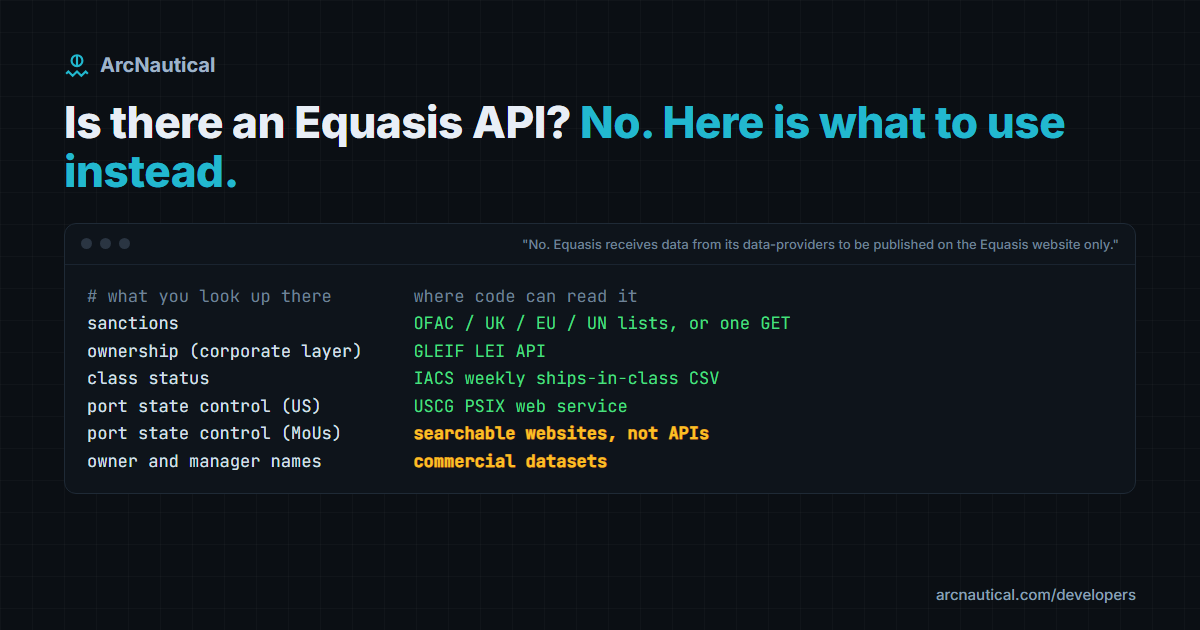
Equasis's own FAQ asks whether it offers data extraction or web services, and answers: No. Equasis receives data from its data-providers to be published on the Equasis website only.
The same answer says this rules out a web service or API feeding another website or an automated process, and that the Conditions of Registration forbid the bulk-download of data from the website.
Accounts whose activity looks suspicious, typically a large number of ships looked up in a short time, get blocked.
So a script that logs in and reads ship pages is against the terms you accepted when you registered, and it tends to stop working the day it matters. The FAQ itself points people who need data in bulk to commercial providers. Before you pay one, it is worth knowing how much of what Equasis shows is published elsewhere in a form code can read.
What you look up there, and where else it lives
Equasis is an aggregator. Most of what it shows comes from someone else, and several of those sources publish directly.
Sanctions
Equasis is not a sanctions tool, but it is often where people go to confirm a hull before they screen it. The lists themselves are published for download: OFAC through its Sanctions List Service, and the UK, the EU and the UN their own lists. Matching a ship against them well is the hard part: IMO numbers are missing from many entries, names collide, and hulls get renamed.
That is what our check does in one call, with no key:
curl https://arcnautical.com/api/v1/vessels/9034690/checkIt returns the name our sources hold for the hull, a sanctions verdict against OFAC SDN, the UK list, the EU Financial Sanctions Database, the UN list and OpenSanctions' maritime dataset, an ownership opacity score and a vetting grade. The fields are in the API docs, and there is a Python walkthrough that screens a whole list.
Ownership
Equasis names the companies behind a ship, starting with the registered owner. Nobody publishes those names as an open API for every ship. What is open is the corporate layer: GLEIF runs a free JSON API for Legal Entity Identifiers, which gives a company's legal name, address and, where reported, its parent. Many shipowning companies have no LEI, which is itself worth knowing.
Our API does not return the owner's name. It returns how hard the ownership is to trace, as a 0 to 100 score with the lines it is made of, such as "Owner not identified, so no LEI (GLEIF) lookup was possible" or "OFAC-designated entity in ownership chain". If you need the name itself in code, that is a commercial dataset.
Class
The class status Equasis shows is reported by the classification societies. IACS publishes a weekly CSV of ships in class with its members: IMO number, ship name, society, last and next survey dates and status. The files are even named "EQUASIS Data", because that is the feed. For a script that needs "is this hull in class with an IACS society, and when is the next survey due", it is the source to read.
Port state control
This is the one people miss most. PSC inspection and detention records belong to the regional MoUs (Paris, Tokyo, the Mediterranean, Indian Ocean, Black Sea, Abuja, Caribbean, Viña del Mar, Riyadh) and the US Coast Guard. The MoUs publish them as searchable websites, not APIs, and some restrict reuse of what you find there, so read each one's terms before you automate anything.
The exception is the US Coast Guard. Its PSIX service offers a free SOAP web service, with no login, covering the vessels the Coast Guard has examined: inspections, deficiencies and control actions such as detentions. The service description is at https://cgmix.uscg.mil/xml/psixdata.asmx?WSDL. One warning from using it: search by IMO number, which PSIX calls the VIN, never by name. A name search is a substring search over every vessel the Coast Guard knows, pleasure craft and fishing boats included, and the first result is often a different ship.
Our API sits one level up. It does not hand back inspection records. On a key, the screening record carries vetting.detention_count, which is null when we hold no PSC record for the hull rather than a misleading 0, and a detention_history factor inside the vetting grade. The keyless check gives the grade alone. Which regimes feed it, and the gaps, are in the methodology.
What none of this replaces
Equasis is free and authoritative for one ship at a time, read by a person, and it should stay in that workflow. What changes is the batch: the list of 200 hulls on Monday morning, the nightly re-check of a fleet, the field in your own system that should say "sanctioned" before anyone opens a browser. That is what the sources above, and our API, are for.
Try the check that needs no account
Paste curl https://arcnautical.com/api/v1/vessels/9811000/check into a terminal, then read the API docs. A free key, with no card, returns the full screening record.