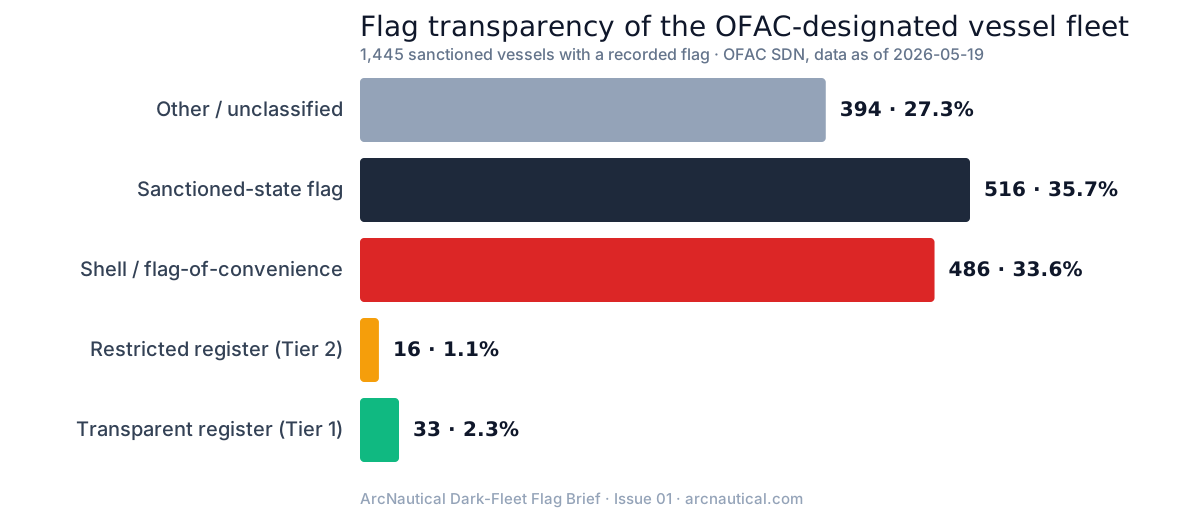
The US Treasury's Specially Designated Nationals (SDN) list currently carries 1,480 vessel entries. We took every one of them and asked a single question: what flag is it flying, and is that flag a jurisdiction where you can actually look up who owns the vessel?
The answer is the reason this Brief exists. Of the 1,445 designated vessels for which OFAC records a flag, 33 fly a flag from a transparent, publicly-queryable beneficial-ownership register. Thirty-three. The other 1,412 — 97.7% — do not.
That is not a number anyone publishes for free. So we are going to — every time OFAC refreshes the list — and we are going to show our working.
What "transparent" means here — precisely
This is the part that has to be airtight, so we are defining it narrowly and on the record. A flag counts as transparent only if the flag state is an EU member, the United Kingdom, Norway, or Iceland — jurisdictions that operate a beneficial-ownership register you can actually query, under 5AMLD or the UK's Companies House PSC regime. That is the exact "Tier 1" definition in jurisdiction-tiers.ts — the same module that decides the ownership-opacity score on every ArcNautical vessel dossier. The Brief cannot contradict a dossier because it is the same code.
Note what the headline does not claim. It does not claim 97.7% of these vessels are shell-owned, or that every non-transparent flag is a flag of convenience. It claims something narrower and unarguable: almost none of the OFAC-sanctioned fleet flies a flag where ownership is publicly checkable. Everything below decomposes that 97.7% honestly — including the parts that are messy.
The other 97.7%, decomposed
The non-transparent mass is not one thing. It is four very different things, and conflating them is exactly the analytical error this Brief refuses to make:
| Flag category | Vessels | Share | What it is |
|---|---|---|---|
| Sanctioned-state flag | 516 | 35.7% | Russia 246 · Iran 156 · DPRK 73 · Venezuela 38. A state-instrument flag, not a commercial registry. |
| Shell / flag-of-convenience | 486 | 33.6% | Panama 260 · Liberia 63 · Palau 55 · Cook Islands 38 · Comoros 35. UBO disclosure intentionally restricted. |
| Other / unclassified | 394 | 27.3% | Heterogeneous: China 166, emerging grey registries (Barbados 65, Gabon 30, Cameroon 22), and falsified flags. Not claimed as uniformly anything. |
| Restricted register (Tier 2) | 16 | 1.1% | UBO required by law but the register is closed to the public (US, Singapore, etc.). |
| Transparent register (Tier 1) | 33 | 2.3% | EU / UK / Norway / Iceland — public, queryable UBO register. |
The "Other / unclassified" row is deliberately a residual. It is the row where an honest methodology shows its seams: China's registry is real but not transparent in the 5AMLD sense; Barbados, Gabon and Cameroon are emerging open registries that watchdogs increasingly treat as flags of convenience but which we do not assert as such here. We would rather report a precise residual than inflate the shell number with cases we cannot stand behind.
A vessel's flag is the cheapest signal in maritime risk, and on the sanctioned fleet it points almost uniformly away from transparency. The exceptions — 33 of them — are the anomaly worth a second look, not the rule.
The falsified-flag tail
Inside the residual is a small, unambiguous signal worth isolating. Eighteen designated vessels claim the flag of a state that has no genuine ocean-going registry: San Marino (12), Mongolia (3), and Eswatini (3) — landlocked countries, two of them with no maritime coast at all. A seagoing vessel cannot be legitimately San Marino-flagged. This is a falsified-registration indicator, not a flag-of-convenience choice.
Eighteen is a small number and we are not going to dress it up as more than it is. But it is eighteen sanctioned hulls broadcasting a registry that cannot exist, and it sits in the public OFAC data for anyone who counts it.
Across every major OFAC program, transparent-flag share rounds to zero
Splitting the fleet by the sanctions program each vessel is designated under removes any doubt that the headline is an artefact of one program dominating the list. It is not. Of the ten largest programs by vessel count, the share flying a transparent flag is 0% in nine of them, and 1.6% in the tenth.
| OFAC program | Designated vessels | On a transparent flag |
|---|---|---|
| RUSSIA-EO14024 | 425 | 0 (0%) |
| IRAN-EO13902 | 268 | 0 (0%) |
| UKRAINE-EO13662 | 182 | 0 (0%) |
| GLOMAG | 157 | 0 (0%) |
| IFSR | 128 | 0 (0%) |
| SDGT | 124 | 2 (1.6%) |
| NPWMD | 122 | 0 (0%) |
| IRAN-EO13846 | 117 | 0 (0%) |
| DPRK4 | 57 | 0 (0%) |
| DPRK | 28 | 0 (0%) |
Why this is the number that matters
For anyone vetting a counterparty hull — a chartering desk fixing cargo, a P&I correspondent taking on a risk, an underwriter pricing one — the flag is the first field you see and the cheapest to check. What this Brief establishes is the base rate: on the sanctioned fleet, a transparent flag is the 2.3% exception. That does not make a Panama or Liberia flag disqualifying — most of the world's clean tonnage flies one too — but it does mean the flag alone tells you almost nothing on the way in, and the 33 transparent-flagged designated vessels are the ones where the flag actively misled.
Source: US Treasury OFAC SDN list (sanctionslistservice.ofac.treas.gov), data as of 19 May 2026, parsed by the ArcNautical production screening engine. Corpus: all 1,480 SDN entries typed as vessels; 1,445 (97.6%) carry a flag on record, 35 do not — the 35 are excluded from the percentage base, not silently dropped. Classifier: the flag-to-transparency-tier mapping is server/arcnautical/scoring/v1/jurisdiction-tiers.ts, the same module that scores ownership opacity on every vessel dossier. What we deliberately did not do: OFAC records a usable tonnage figure for under 4% of designated vessels, so this Brief is reported by vessel count, not tonnage — a tonnage-weighted headline would be computed from an unrepresentative ~4% sample and would not survive scrutiny. Reproduce it: re-pull the SDN CSV from the source above and re-run scripts/dark-fleet-flag-brief.ts; every figure here is regenerated from that snapshot. We would rather show the seams than round them off.
This is Issue 01. The ArcNautical Dark-Fleet Flag Brief recomputes on each OFAC SDN refresh — same method, same classifier, numbers moving as the list moves. If you work this data and you read the methodology differently, we want the argument: the point of publishing the working is that it can be checked.